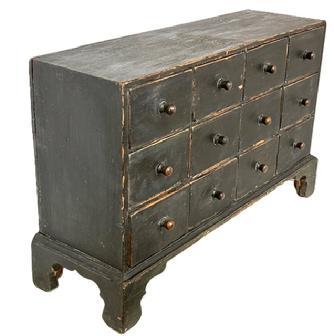
**SOLD** L406 19th century New England 12 drawer Apothecary in original Windsor green paint with dovetailed case and drawers, resting on an applied bracket base with decoratively cut out feet. The wood is pine with small wire nail and dovetail construction. Circa 1840's.
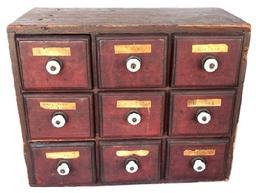
L359 19th century Pennsylvania nine-drawer spice chest / apothecary bearing original red painted surface with molded edged drawers bearing original porcelain knobs and original paper labels. Tiny square head nail construction. Circa 1840-1850’s.
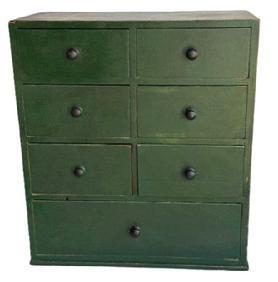
L371 18th century Pennsylvania seven (7) drawer apothecary beautiful old green painted surface with all the original knobs. Dovetailed case and drawers with the stretchers being dovetailed into the sides and mortised through the top. Circa 1790-1810.
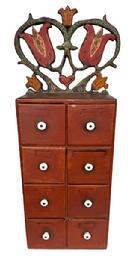
**SOLD** L265 Pennsylvania Folk Art carved and painted eight-drawer Apothecary / Spice Cabinet with original red painted surface Circa 1900-1910.
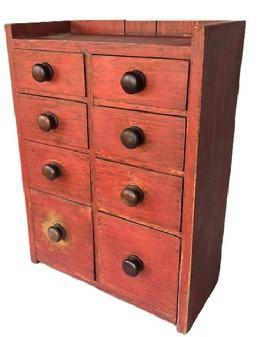
**SOLD** L398 Mid-19th century Pennsylvania eight (8) drawer apothecary / set of drawers with original red painted surface.
L195 19th century Pennsylvania hanging set of four drawers bearing its green painted surface. Drawers have molded edges. Small wire nail construction with original knobs. Circa 1870s.
*SOLD* K1731 Twelve drawer 19th century Apothecary bearing vivid old blue over original green painted surface featuring three rows of drawers with mortised stretchers. The bottom row of drawers if slightly larger than the top two rows. Each of the drawers has shaped sides and original pale-yellow painted interiors. Found in Pennsylvania.
**SOLD** J262 Small hanging stack of drawers bearing early red painted surface with pinstriping on drawer fronts. Drawers are dovetailed. Combination of “T” and wire nail construction.
K1541 Early 19th century New England set of three drawers bearing original gray painted surface. Dovetailed drawers and dovetailed case construction. Very sturdy. Circa 1840s-1850s.
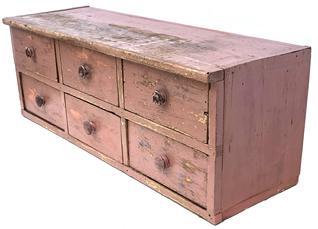
**SOLD** J202 Late 19th century Pennsylvania Country Store counter six-drawer apothecary retaining the original salmon painted surface. Very faint remnants of blue painted writing that once identified drawer contents remains on some drawers. Square head nail, one-board construction with solid ends and original knobs. Clean, natural patina drawer interiors.
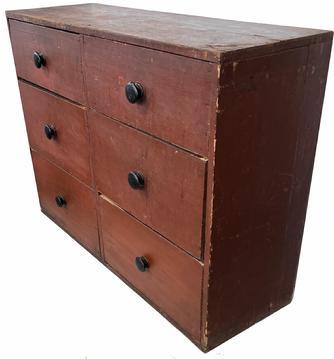
H384 Mid 19th century New England apothecary chest in original red paint with six drawers. Square head nail construction.
J126 Late 19th century Pennsylvania original Mustard painted apothecary / spice cabinet featuring an unusual 18 drawer layout with brass pulls. The drawer stretchers are mortised into the ends. A decorative cut out backsplash adorns the back while a chamfered edge surrounds the other three sides of the top.
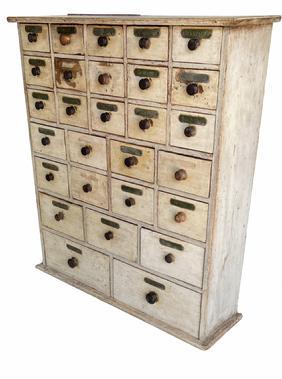
**SOLD** H374 Early 19ty century American original oyster white painted twenty-five drawer Apothecary Cabinet. The case is dovetailed as well as the dividers, and the drawers retain their original metal labels. This Apothecary is made of pine. Simple moldings around top and base. This apothecary can be hung on the wall or free-standing. Circa 1840.
K232 Large, late 19th century Apothecary jar with tin lid. The jar is a hand-blown clear glass with remnants of the pontil on base. The glass is wavy with minor air bubbles and fine scratches in some places.